

How I Generate More Essay Ideas Than I Can Write: The Editorial Witness
Journal Prompts & Quests: Or... The Real Reason You Can't Find an Essay Idea (It's Not Writer's Block)
This is a Quest. Every Quest is a free essay with extended benefits. The essay explains the thing. The Quest gives you the system to do the thing. Don’t forget Subs get FREE Heroine’s Guide to Designing an Extraordinary Life

When you open a blank essay in Substack, are you like me, itching to get started with one of the long list of essay ideas you have collected? Or do you stare at that flashing cursor for 5, 10, maybe 15 minutes, willing your brain to pull an idea from your brain-fogged midlife, messy middle, mind?
Some people say that you should only write on Substack if you have something to say. And you agree! That’s the thing... You know you have something to say. You have a million things to say. You just don’t know what the thing you have to say is at this specific moment in time (I mean, what are you supposed to be, an idea robot? Stick a quarter in your back and you write an essay on demand?).
What would you say if I told you that I have a foolproof method that will help you fill your essay queue to the brim and even spill over? That I could help you dig up all those essays that you want and need to draw from your current identity (thanks to peri and menopause) as the Ultimate Wise Woman. And yes, that moniker deserves capitals. And maybe even periods. Ultimate. Wise. Woman.
I call this foolproof method “The Editorial Witness,” and it’s the secret key to unlocking the ideas, stories, lessons, and deep, abiding wisdom you have spent decades collecting.
Let’s start at the beginning, shall we? I write morning pages every morning. For those of you who have never heard of Julia Cameron and “The Artist’s Way”, morning pages are Julia’s attempt to help us creatives get out of our own way, or clear our busy monkey brains so we have the space to actually make things. Julia asks for 3 handwritten pages. My hand can’t do that (thanks, psoriatic arthritis!), so I type my morning pages and for many, many years have been using a website called 750 Words.
This morning, I was writing my pages as usual, but halfway through, I kinda lost steam, and I paused writing to read back what I’d just written. Two thousand words. I’d written about the Story Room launching. I reported that I’d published a fiction post. I was waxing lyrically about my personal discipline, having been to the gym and lifted weights three times in the past week. I waffled on about the conversations Mark and I are having about a scary project we are considering. I complained about a swollen hand I’m choosing to ignore (thanks, psoriatic arthritis!).
After these content-rich two thousand words (seriously, a wealth of ideas I couldn’t see), I still wrote, in the middle of them, “I seem to have limited stuff to write in my words, and I don’t know why.“
I kept writing, because I always finish my 750 words even if I have to write, “I hate writing 750 words” one-hundred and fifty times (which is how many times you’d have to write that sentence to write 750 words.) And then I consulted with my Editorial Witness, who highlighted that “limited stuff” sentence and questioned whether that was actually true, given all the stuff I had actually written about, and I realized there was a real problem here that other people (maybe you) have that I can most definitely help with. The real problem is not the absence of material. It’s the opposite. Because by the time you reach your second coming-of-age, you have so much material that it has become invisible to you. It’s just... life. You stop seeing it. The richest stretch of your years is unfolding right now (your glorious mucky middle), and you can’t find a sentence to write about it.
Let me tell you why that happens, and about what I built to stop it from happening to me.
All of us, Ultimate. Wise. Women., are walking around with at least forty years of unused material.
Stories you’ve told a few times at a dinner party and forgotten how crazy they were. Maybe patterns you’ve noticed but never connected or named. Insights you earned the hard way from coaching hundreds of midlife women trying to start businesses. That epiphany you experienced. The afternoon in the Italian piazza where you understood something you never even knew you needed to.
This is the material of your rebirth, or your self-curation. It is the goo of your messy middle. And most women don’t even use it.
You all have it. You just need someone to witness it so you can discover it all again.
The thing you’re missing is your Editorial Witness.
A witness is the person who listens, takes notes, reads back what you just said, and then tells you which juicy bits were the most interesting. A witness notices those same old tired themes you can’t let go of and alerts you when you keep circling. Who says, “You’ve mentioned that twice in three weeks. What are you actually wrestling with?”
In another life, this Editorial Witness was most likely a therapist (that’s if you have the $200 an hour to hire a therapist!). Or it could have been an editor (if you were skilled and/or lucky enough to have one). Or, most likely, it was a best friend who got you.
Most midlife women don’t have any of those. So the material accumulates. And evaporates. And accumulates. And evaporates.
But the good news is that you can build yourself a system (for free, or very low cost) that can become The Editorial Witness, or the foolproof method.
Here’s what the system is composed of:
The first part is morning pages. Three pages, by hand or on a screen, every morning. No filter. Whatever’s there. Julia Cameron has been telling us to do this for thirty years. She’s right. But she stops there. Some people re-read their morning pages. Some people slide them into a drawer, and they never see the light of day again. They just get lost under a pile of staples, scrunchies, loose change, and five pairs of scissors. You will be mining yours for the juicy stuff.
The second part is the witness. This is where it gets interesting, and where I’d guess I might lose some of you. If you’re anti-AI, I get it, and I’d just ask that you stay with me for a beat, because what I’m describing isn’t what you think it is. The witness is a conversation with Claude (or any AI thinking partner) set up specifically to read what I’ve just written and notice things. Claude does NOT write for me. Claude does NOT invent my ideas. Claude witnesses. She points out what I’m circling, what I keep avoiding, where I just contradicted myself, and which line might actually be an essay seed.
I want to be clear about what this is and isn’t. This isn’t taking the work off your plate. You still have to put in the grind. The AI does not write your morning pages or your essays. You do. The AI does not generate the ideas. The ideas are already in your pages, but you just can’t see them because you’re too close. The AI does the job a good editor or therapist would do: it reads back to you what you just said in a way that lets you see it for the first time.
This is a different relationship to the tool than most people have. Many people use AI as a writer (which, for me, is giving away the fun part). I use AI as a reader. And that distinction is the whole game.
The third part of The Editorial Witness is storage. I constantly capture what surfaces within the system and automate it so that it returns the results to me later. That means the gold doesn’t sink again.
You know what all this means? Bundles and bundles of essay ideas just begging to be written. Here’s only the first page of what I have in mine...
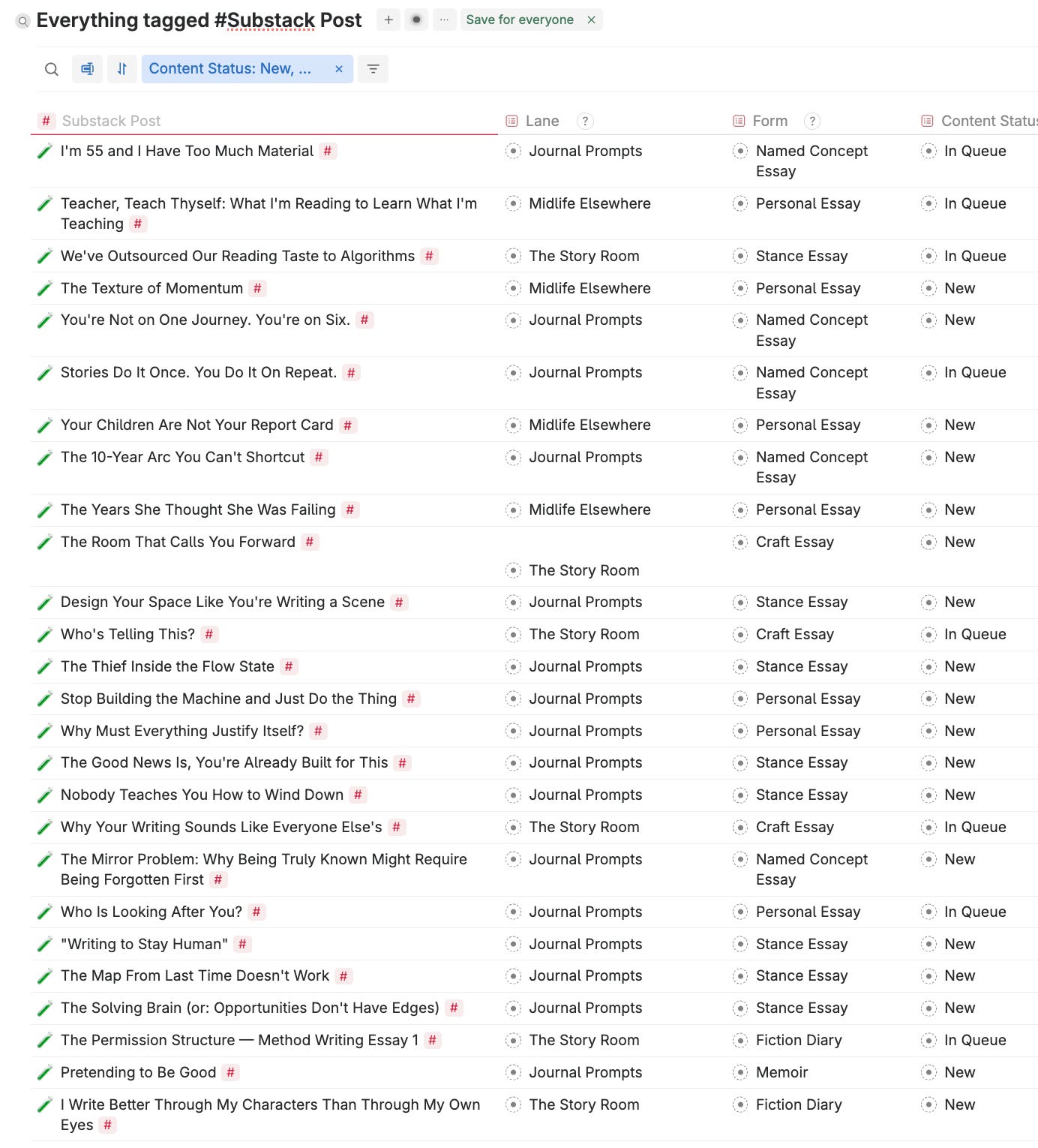
You are an Ultimate. Wise. Woman. Your life is giving you material right now. It does not stop. It is happening this morning. It happened last week. It happened in the conversation you had on Thursday that you’ve already half-forgotten. It happened in the thing your daughter said in passing that you noticed and then let evaporate.
What I’ve found is that once you build a system to surface this material, your relationship to your own life changes. You stop feeling like nothing is happening. You start noticing the delicious texture of your own days. You become present. You begin to suspect, correctly, that you are probably the most interesting person in the room, but that nobody, including you, has ever bothered to write it down.
The next chapter of your life is asking to be made legible, and The Editorial Witness helps you do that.
If you want to learn the entire setup, and grab the templates and prompts, paid subscribers can grab the Editorial Witness Quest in The Library, where all the Heroine’s Adventure resources are available.
JOURNAL PROMPT
What’s a story you’ve told at three dinner parties and never written down? Why haven’t you written it? Write the version of the story you’d tell if you trusted that it mattered.

P.S. If you’ve been circling a Story Room submission and don’t know where to start, the Quest includes a section on how to use this exact system to surface an idea that could win you prize money and/or exposure.

Here’s how I can help…
Become a paid subscriber.
You get the full Heroine’s Adventure course (7 chapters, 40+ videos), every Questbook as it’s published, Midlife Elsewhere — my weekly dispatch from the messy middle, with the thinking still wet on the page — and the participatory layer of The Story Room: workshop threads, Book Club archive, prize feedback. The work, unfiltered. $9.95/month or $90/year.
Retreat with me.
Three, four or seven days. Just you (or a small group of friends) in a place worth thinking in. We use the Heroine’s Adventure framework to finish something real: an essay, a novel outline, a point of view, or a map of where your life is going next. High-touch, rare, and nothing like a standard retreat.
Build your business.
The Build is for women who know what they want to make but can’t see the shape of it yet. Over 4–6 weeks we sit down together and you leave with the whole thing: business plan, brand positioning, financial projections, a 90-day launch roadmap, and a custom AI advisor trained on your strategy. You do the work. I build the map.
P.S. — The Elixir Shop is open. Merch for heroines in the middle of reinventing everything. New items added regularly. You’ll know your phrase when you see it.
This made me stop and think because it explains something I could never quite name. Most of us do not lack ideas in midlife. We are drowning in unprocessed life.
You are right , The problem is not emptiness. It is proximity. We are standing too close to our own wisdom to recognize it as material.
And honestly, AI as a reader, not a writer, is the best nugget of the day . Thank You !
That distinction changes everything.
I use Claude as a reader and it's like having a personal editor at my fingertips! Also, how hard are you laughing at me now using AI;)